
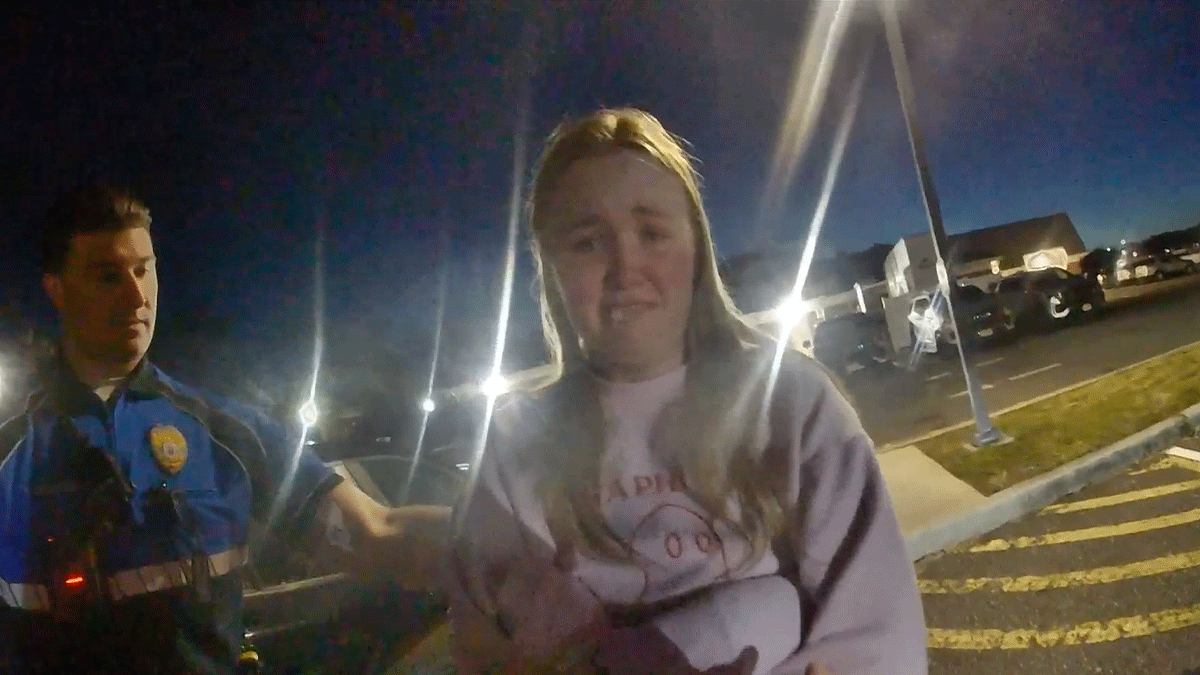

The Wall Township Police Department DWI Arrest of 20-year-old Paige K. Finnegan began with a discovery that left veteran officers speechless. On the evening of March 3, 2024, a vehicle was spotted in the very place a drunk driver should avoid at all costs: the police headquarters parking lot.
Table of Contents
Watch: Wall Township Police Department DWI Arrest Caught on Camera
Note: Pay close attention to the timestamp at 00:25:48 where the situation escalates as the suspect officially refuses the breathalyzer test.
Full Story: How the Incident Unfolded
The evening started like any other for the officers at 2700 Allaire Road in Wall Township, New Jersey. However, at approximately 6:16 PM, the nature of the shift changed when a suspicious vehicle was noted. A black 2017 Mazda M3S was found parked in a spot at the Wall Police Headquarters.
When patrols approached the vehicle, they found Paige Finnegan passed out at the wheel. The irony of the situation was not lost on the responding officers, who later remarked that this was a first in the history of the department.
Officer Tyler D. Martin (Unit W210) took the lead on the investigation. Upon making contact, it became clear that Finnegan was under the influence. The bodycam transcript reveals a young woman who was emotional, scared, and seemingly unaware of the gravity of her location.
The Field Sobriety Tests
Despite being in a police parking lot, Officer Martin followed standard protocol to ensure a lawful Wall Township Police Department DWI Arrest. He led Finnegan through several field sobriety tests, including the “Walk and Turn” and the “One-Leg Stand.”
During the Walk and Turn, Finnegan struggled significantly. “I’m sorry,” she repeated as she lost her balance. Officer Martin, maintaining a professional yet empathetic tone, encouraged her to finish.
The “One-Leg Stand” followed, with Finnegan counting out loud. While she managed to count to 1020, her overall performance and the initial observation of her “passed out” state provided the necessary probable cause for an arrest.

Refusal at the Station
The situation reached a critical turning point once Finnegan was brought inside the station for processing. Officer Martin read the standard New Jersey Attorney General’s statement regarding breath samples.
The law in New Jersey is clear: by driving on public roads, you give “implied consent” to breath testing. When asked if she would submit samples, Finnegan’s response was a definitive “No.” Despite being warned that this would lead to a separate “Refusal” charge, she stood by her decision.
The Arrest: Charges Against Paige K. Finnegan
The Wall Township Police Department DWI Arrest resulted in five separate summonses being issued.
| Charge | Simple Explanation | Potential Penalty (US) |
| 39:4-50 | Operating Under Influence of Liquor or Drugs | Fines, loss of license, and installation of an ignition interlock device. |
| 39:4-50.4A | Refusal to Submit to Chemical Test | License suspension up to 20 years and heavy surcharges. |
| 39:4-50.14 | Underage DWI (Person under 21 who consumed alcohol) | 30-90 day license suspension and community service. |
| 39:4-96 | Reckless Driving | Fines, points on license, and potential jail time. |
| 39:4-50.2 | Consent to Take Samples | Procedural charge related to the refusal of the breath test. |
Legal Analysis: Was the Wall Township Police Department DWI Arrest Justified?
From a legal standpoint, this case is highly unique but straightforward.
Fourth Amendment Check: The Fourth Amendment protects against unreasonable searches and seizures. However, in this case, the “stop” was not a traditional traffic stop. The vehicle was already stationary in a public parking lot (specifically, a police station). Officers have the right to investigate “suspicious vehicles,” and finding a driver passed out at the wheel immediately establishes “community caretaking” and reasonable suspicion of a medical emergency or intoxication.
Police Protocol: Officer Martin followed the “John’s Law” protocol, which is a New Jersey statute requiring police to impound the vehicle of a DWI arrestee for at least 12 hours. The transcript shows the officer explaining to Finnegan that her father would have to sign her out and take responsibility for her.
Implied Consent: The Wall Township Police Department DWI Arrest highlights the severity of the Refusal charge. In New Jersey, you cannot “plea bargain” a DWI or a Refusal charge down to a lesser offense like “Reckless Driving” in most cases. By saying “no” to the breathalyzer, Finnegan essentially guaranteed a license suspension regardless of what her Blood Alcohol Content (BAC) might have been.
[Read more Evidence Decode investigations here]
Here are 5 Frequently Asked Questions (FAQs) that are connected to the charges and procedures mentioned in this case:
What is “John’s Law” and how does it affect a DWI arrest?
John’s Law is a New Jersey statute that allows police to impound a vehicle for at least 12 hours following a DWI arrest. The law was designed to prevent intoxicated drivers from reclaiming their cars and getting back on the road immediately after being released from custody.
Can you be charged with a DWI if the vehicle is parked and the engine is off?
Yes. In New Jersey, you can be charged with a DWI even if the vehicle is not in motion, provided the officer can prove “intent to operate” or that you were in physical control of the vehicle. In this case, the suspect was found passed out at the wheel while the vehicle was in a parking spot, which was sufficient for the arrest.
What are the legal consequences of refusing a breathalyzer test?
Under New Jersey’s “Implied Consent” law, by driving on public roads, you have already agreed to submit to chemical breath testing. Refusing to provide a sample results in a separate criminal charge (Refusal to Submit) that carries penalties similar to—and often in addition to—a DWI conviction, including license suspension and heavy fines.
How does an “Underage DWI” charge differ from a standard DWI?
New Jersey has a “Zero Tolerance” policy for drivers under the legal drinking age of 21. While a standard DWI usually requires a Blood Alcohol Content (BAC) of 0.08% or higher, a person under 21 can be charged with a violation (39:4-50.14) if they have a BAC as low as 0.01%.
Is a DWI considered a criminal offense or a traffic violation in New Jersey?
In New Jersey, a DWI is technically classified as a “quasi-criminal” traffic offense rather than a felony or misdemeanor. However, it is handled in Municipal Court and appears on your driving record permanently, often carrying penalties as severe as criminal convictions, such as jail time and significant surcharges.
Conclusion & Current Status

Paige Finnegan was processed and released into the custody of her father, Brian, in accordance with John’s Law. Her vehicle was impounded for 12 hours.
The case was scheduled for a hearing at the Wall Township Municipal Court on March 19, 2024. While the suspect expressed deep regret during the recording, saying, “I’m sorry I did this… my life is over,” the legal process will determine the long-term consequences of this ill-fated parking choice.
Download Police Report click here.
Disclaimer: All suspects are presumed innocent until proven guilty in a court of law. This report is based on official police records.
Don’t Rely on Their Word Alone In this case, conflicting stories led to an arrest. The only way to prove your innocence in a traffic stop is with your own 4K evidence. Protect yourself this holiday season. 🎄 Click Here