


In a shocking display of disregard for public safety and police warnings, a 55-year-old woman was arrested for driving while intoxicated in Highlands, New Jersey, just hours after officers had visited her home for a separate incident. The incident occurred in the early morning hours of March 31, 2024, involving the Highlands Police Department. This bodycam footage is going viral not just because of the arrest, but because the arresting officer immediately recognized the driver. Earlier that same night, he had responded to her home regarding a dog bite and had explicitly warned her not to get behind the wheel because she appeared intoxicated. Despite promising to take an Uber, she decided to drive, leading to a tense confrontation on State Route 36.
Table of Contents
YouTube Bodycam Embed Section
3. Full Chronological Narrative (Full Details)
The Stop
It was approximately 2:23 AM on March 31, 2024. Sergeant McGrath of the Highlands Police Department was on patrol when he spotted a black 2015 Jeep Wrangler traveling northbound on State Highway 36 near Danielle Court. The officer noticed the vehicle had a reflective cover over the license plate, which made it impossible to read the numbers clearly. This violation gave the officer probable cause to initiate a traffic stop.
As Sgt. McGrath approached the driver’s side window, he immediately realized this was not a routine stop. He identified the driver as Angelica Camacho, a resident of Hazlet, New Jersey. The recognition was instant and frustrating for the officer.
The Confrontation
The moment the officer made contact, the dynamic shifted from a standard ticket to a serious confrontation about honesty and safety. Sgt. McGrath asked for her license and registration, but then he dropped a bombshell question.
“Did I tell you not to drive?” the officer asked pointedly.
Camacho attempted to deflect, asking, “Sir?”.
The officer didn’t let up. “I’m not under the influence,” Camacho claimed. However, the officer had been at her home earlier that evening regarding a domestic incident involving her dog. During that previous interaction, he observed signs of intoxication and advised her strictly to stay off the road.
Signs of Impairment
Despite her denials, the physical evidence was adding up quickly. Sgt. McGrath noted a strong odor of an alcoholic beverage coming from the vehicle. As Camacho fumbled to find her documents, the officer observed her hands were shaking visibly.
The situation was complicated by the presence of a dog in the vehicle—the same dog involved in the earlier biting incident. The officers knew they couldn’t just tow the car with the animal inside. They began a frantic attempt to contact Camacho’s family members, specifically her sister Nicole, to come retrieve the pet so the officers wouldn’t have to call animal control.
Field Sobriety Tests
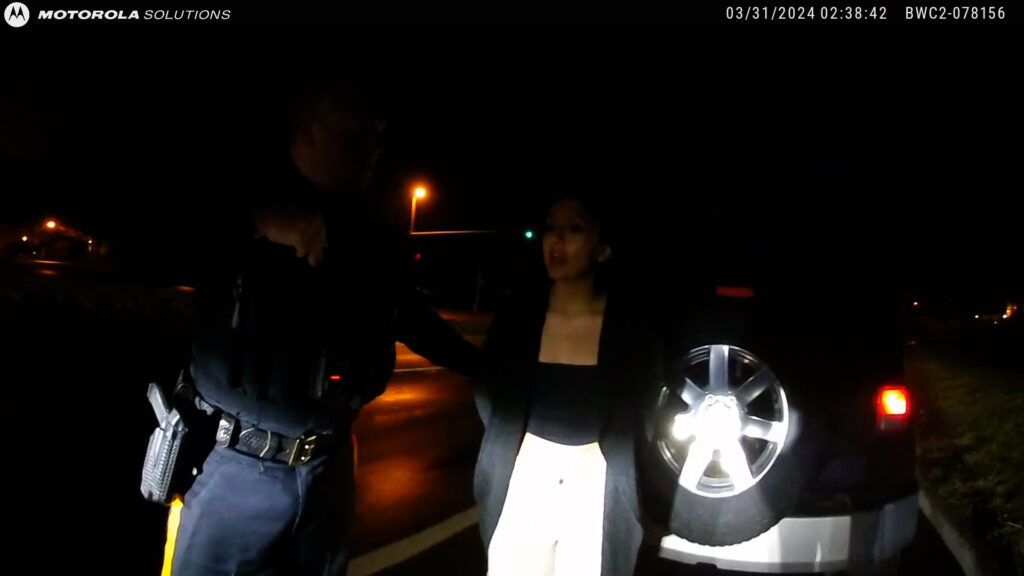
Sgt. McGrath asked Camacho to step out of the vehicle to perform Standard Field Sobriety Tests (SFSTs) to determine if she was safe to drive.
- The Eye Test (HGN): The officer administered the Horizontal Gaze Nystagmus test. He looked for involuntary jerking of the eyes, which happens when someone is impaired. The officer reported “lack of smooth pursuit” and distinct jerking at maximum deviation. He found six out of six possible “clues” of impairment.
- Walk and Turn: The officer instructed Camacho to take nine steps, heel-to-toe, along a straight line. During the test, she struggled to follow instructions. She took eight steps instead of nine on the first pass and failed to touch her heel to her toe on multiple steps.
- The One Leg Stand: Camacho was asked to raise one foot and count. She hopped to maintain her balance—a major sign of impairment—and messed up her counting, repeating “Fourteen-One Thousand” twice and skipping fifteen entirely.
The “Alphabet” Test
In a moment captured on bodycam, the officers asked her if she knew the alphabet. She claimed she did. When asked to recite it, she hesitated.
“Do you write in Spanish, I guess?” she asked, attempting to switch languages.
The officer allowed her to try, but she failed to complete the recitation clearly, muttering letters that did not make sense.
The Arrest
Based on the totality of the circumstances—the odor of alcohol, the failed physical tests, and his observations from earlier in the night—Sgt. McGrath placed Camacho under arrest. She was handcuffed and placed in the rear of the patrol vehicle.
“I advised Camacho that she was being placed under arrest for operating a motor vehicle under the influence,” McGrath noted in his report. Even during the drive to the police station, the smell of alcohol filled the patrol car.
At the Station
Once at headquarters, the legal gravity of the situation set in. The officers read Camacho her Miranda Rights, and she declined to answer questions. However, under New Jersey’s implied consent laws, she was required to provide a breath sample.
The breathalyzer process was difficult. Camacho struggled to provide a continuous breath sample, with the officer repeatedly coaching her: “Keep going, keep going, keep going”. After several attempts, the machine finally registered a valid reading.
The Result: Camacho’s Blood Alcohol Content (BAC) was 0.137%. This is nearly double the federal legal limit of 0.08%.
The Arrest and Charges
H2: Charges Filed Against Angelica V. Camacho
Following the investigation, the Highlands Police Department filed three specific charges against the defendant.
- DWI (Driving While Intoxicated)
- Reckless Driving
- Unclear Plates
Legal Breakdown of Charges
| Charge Name | Legal Statute | Simple Meaning | Potential Penalties (NJ)* | Why It Applies |
| DWI (Driving While Intoxicated) | N.J.S.A. 39:4-50 | Operating a vehicle with a BAC of 0.08% or higher, or while impaired by drugs/alcohol. | License suspension (3-12 months), fines ($300-$500), IDRC classes, possible ignition interlock device. | Suspect blew a 0.137% BAC and failed field sobriety tests. |
| Reckless Driving | N.J.S.A. 39:4-96 | Driving in a way that willfully endangers life or property. | Points on license (5 points), fines ($50-$200), possible jail time (up to 60 days). | Police argue that driving while intoxicated, especially after being warned not to, showed “willful” disregard for safety. |
| Unclear Plates | N.J.S.A. 39:3-33 | Having a license plate that is dirty, covered, or unreadable. | Fine ($50-$100). | The suspect had a “reflective cover” over her tag, which is illegal in NJ. |
*Note: Penalties vary based on prior offenses. This appears to be treated as a first offense in the context of the dialogue.
Why This is Serious
The most shocking aspect of this case is the Recidivism Risk. The suspect had an interaction with law enforcement just hours prior. The fact that she blew a 0.137% indicates she was significantly impaired. In New Jersey, traffic offenses like this are technically not “crimes” (felonies/misdemeanors) but “motor vehicle offenses,” yet the Reckless Driving charge adds a layer of severity regarding her decision-making.
What Happened Before Police Arrived
To understand why the officer was so frustrated, we have to look at the timeline before the traffic stop.
According to the official police report, Officer McGrath had responded to Angelica Camacho’s residence earlier that same evening. The call was regarding a domestic issue: Camacho’s dog had bitten her boyfriend.
While investigating the dog bite, the boyfriend told the officer that Camacho “should not be driving a motor vehicle due to her consumption of alcohol”.
Sgt. McGrath took this warning seriously. He spoke directly to Camacho at her home. He observed that she seemed impaired and gave her a lawful order/warning: Do not operate your vehicle. Camacho explicitly agreed to this, telling the officer that “she would not be driving and if needed she would call for an Uber”.
This context is critical. It destroys any defense that she “didn’t know” she was too drunk to drive. She had been assessed by a professional (the officer) and a witness (the boyfriend) and had made a verbal contract with the police to stay off the road—a contract she broke a few hours later.
Expert Opinion & Legal Analysis
As a legal analyst reviewing this case, I am looking at the procedure used by the Highlands Police Department to ensure the arrest was constitutional and the evidence will stand up in court.
1. The Stop (Fourth Amendment Justification)
The Fourth Amendment protects citizens from unreasonable search and seizure. Police cannot stop you just to “check” if you are drunk. They need Probable Cause (PC) or Reasonable Suspicion of a crime or traffic violation.
- Analysis: Sgt. McGrath cited the “reflective cover over the license plate” as the reason for the stop. Under New Jersey law (39:3-33), any covering that obscures the lettering or reflects light to defeat cameras is illegal. This gave the officer a valid, legal reason to pull her over. Once the window was down, the “plain smell” doctrine allowed him to pivot the investigation to a DWI.
2. The Pre-Arrest Interaction
The officer’s prior knowledge is a massive aggravating factor for the suspect but a huge boon for the prosecution.
- Analysis: Usually, a defense lawyer tries to argue that the defendant “felt fine” and made a mistake. Here, the officer serves as a witness to her condition before she even got in the car. The statement “Did I tell you not to drive?” establishes that she knowingly acted recklessly.
3. Field Sobriety Tests (SFSTs)
Did the officer administer these correctly?
- Analysis: The officer clearly explained and demonstrated the “Walk and Turn” and “One Leg Stand” tests. He noted specific clues mandated by the National Highway Traffic Safety Administration (NHTSA): hopping, stepping off the line, and incorrect counting. The officer’s documentation of the HGN (eye test) was thorough, noting “distinct and sustained nystagmus”. This is textbook procedure.
4. Implied Consent and “John’s Law”
You will hear the officer mention “John’s Law” in the video.
- Analysis: New Jersey has a specific statute known as John’s Law (N.J.S.A. 39:4-50.22). This law mandates that police must impound the vehicle of a driver arrested for DWI for a minimum of 12 hours. The suspect cannot simply bail out and drive away. Furthermore, the police must release the intoxicated person to a sober responsible adult. The officers followed this strictly, refusing to release Camacho until her friend, Rachel, arrived to sign a liability waiver.
5. Defense Strategy?
Camacho’s defense will be difficult.
- Weakness: She claimed she wasn’t under the influence, but the breathalyzer (scientific evidence) showed 0.137%.
- Weakness: The bodycam footage shows her hopping and losing balance.
- Weakness: Her own boyfriend’s earlier statement establishes a timeline of drinking46.Her best hope would be to challenge the calibration of the breathalyzer machine, but with the bodycam footage showing clear physical impairment, a dismissal is highly unlikely.
The Aftermath / Current Status
Angelica Camacho was processed at the Highlands Police Headquarters.
- Booked: She was fingerprinted and photographed, though the officer explained that in NJ, this is processed as a traffic offense, not a criminal one for FBI database purposes.
- Vehicle: Her 2015 Jeep Wrangler was towed by Hennessey’s Towing and impounded for the mandatory 12-hour hold under John’s Law.
- Release: She was released around 4:00 AM into the custody of a sober friend named Rachel, who signed a Potential Liability Warning form.
- Court: A court date was set for April 16, 2024, at 3:00 PM at the Highlands Municipal Court.
As of the time of this report, the case is pending adjudication in municipal court.
Download Full Police Report PDF
Disclaimer
All suspects mentioned in this article, including Angelica V. Camacho, are presumed innocent until proven guilty in a court of law. This article is based on official police records (Incident 24HL02019) and public bodycam footage provided by the Highlands Police Department. This content is for news reporting and educational purposes only.