
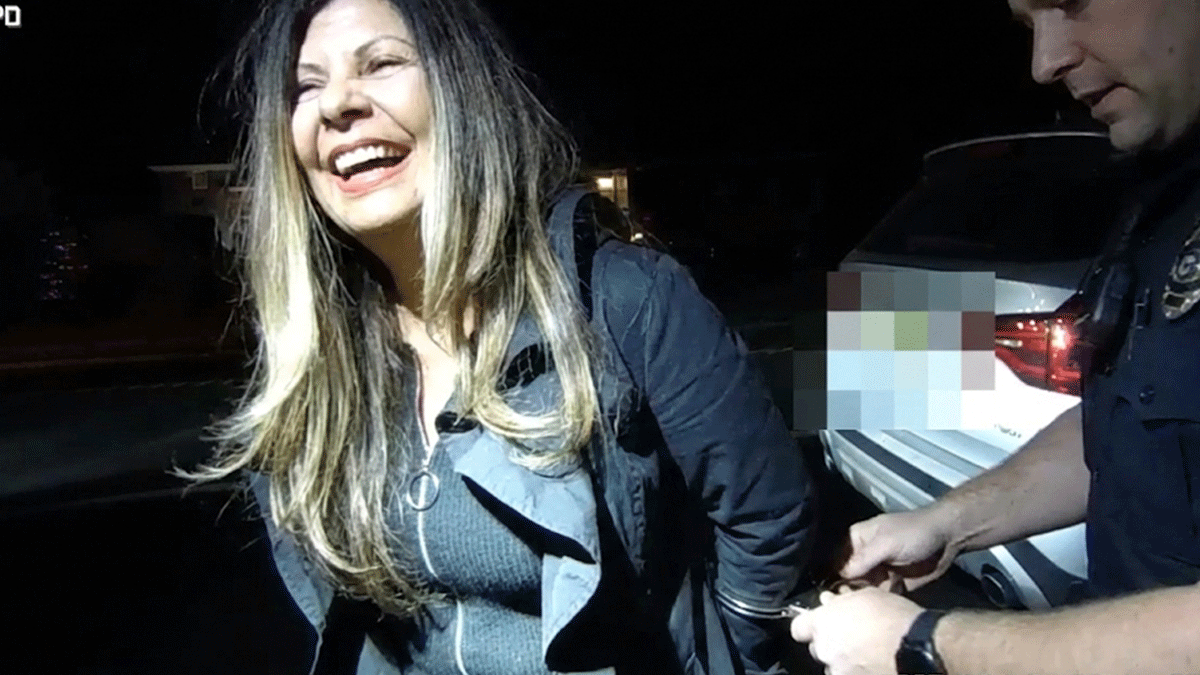

Monmouth Beach DWI arrest footage captures the moment a routine traffic stop turned into a complex legal case on the Jersey Shore.
Officer Flood of the Monmouth Beach Police Department initiated a stop after observing a BMW swerving and driving significantly under the speed limit on Ocean Avenue. What started as a claim of being “just tired” from a long day of real estate work ended with handcuffs, despite a surprising breathalyzer result later at the station.
Table of Contents
Watch: Monmouth Beach DWI Arrest Caught on Camera
Note: Pay close attention to the timestamp at 00:17:48. The suspect attempts to recite the alphabet from C to Y but inserts numbers and ends incorrectly, a key factor in the officer’s decision to arrest.
Full Story: How the Incident Unfolded
The Stop On October 17, 2025, just after 11:00 PM, Patrolman Flood was observing traffic on Ocean Avenue. He spotted a 2019 Silver BMW X3 driving partially on the shoulder.
The vehicle was traveling at roughly 31-33 mph in a 40 mph zone. The officer noted the car swerving within its lane and crossing the solid white shoulder line multiple times. Flood initiated the lights and pulled the vehicle over at Ocean Ave and Vista Court.
The Initial Interaction The driver was identified as Sandra Valencia. When asked about her driving behavior, she claimed she was “tired and working all day” as a real estate agent. She stated she was coming from the Proving Ground restaurant.
Officer Flood observed that Valencia’s eyes were “watery”. When first asked if she had been drinking, she firmly stated, “No”.
The Sobriety Tests Officer Flood called for backup to conduct Field Sobriety Tests (FSTs). Officer Golembieski arrived to perform the Horizontal Gaze Nystagmus (HGN) test. He observed “bloodshot and watery eyes” and noted 4 out of 6 clues of impairment, including a lack of smooth pursuit in her eyes.
During the questioning, Valencia changed her story. She admitted to having “one beer” (a pumpkin ale) about three hours prior.
The physical tests proved difficult for Valencia.
- Walk and Turn: She missed heel-to-toe steps and turned incorrectly.
- One Leg Stand: She swayed, used her arms for balance, and put her foot down.
- The Alphabet: When asked to recite letters C through Y, she recited: “C, D, E… 2… Z,” failing to stop at Y.
The Twist at Headquarters Officers arrested Valencia believing she was impaired. However, back at headquarters, the Alcotest (breathalyzer) reading came back at 0.00% BAC.
Suspecting drug impairment instead of alcohol, officers requested a Drug Recognition Expert (DRE) evaluation. Valencia refused to consent to this additional testing.

The Arrest: Charges Against Sandra Valencia
Despite the 0.00% breath reading, police proceeded with charges based on the observed impairment during the roadside tests.
| Charge | Simple Explanation | Potential Penalty (US/NJ) |
| DWI (39:4-50) | Driving while impaired by alcohol or drugs. | License suspension, fines, potential jail time, IDRC classes. |
| Traffic Offense (39:4-88) | Failure to maintain lane (unsafe lane change). | Fines and points on license. |
Legal Analysis: Was the Monmouth Beach DWI Arrest Justified?
Fourth Amendment Check The initial stop appears legally sound based on the police report. The officer documented specific, articulable facts: driving on the shoulder, swerving, and driving under the speed limit. In New Jersey, “community caretaking” or reasonable suspicion of a traffic violation justifies the stop.
The “0.00% BAC” Complication A Monmouth Beach DWI arrest with a 0.00% BAC presents a unique challenge for the prosecution. The state must prove impairment through “observational evidence” rather than “per se” chemical evidence (like blowing a 0.08%).
- Prosecution’s Case: They will rely on the bodycam footage showing the failed alphabet test, the swaying, and the admission of drinking.
- Defense’s Case: The defense will argue the physical failures were due to fatigue (she mentioned working two jobs) or medical history (she mentioned being a breast cancer survivor). The refusal of the DRE evaluation can be used against her in court to suggest consciousness of guilt regarding drug use.
Police Protocol The officers followed standard procedure by bringing in a second officer for HGN testing to verify findings. They also properly offered the option to remove high heels for stability during tests, which the suspect accepted.
[Read more Evidence Decode investigations here]
5 FAQs connected to the charges in this case (DWI and Traffic Offense):
Can you still get a DWI if you blow a 0.00% on the breathalyzer?
Yes. In New Jersey, a DWI charge (N.J.S.A. 39:4-50) is based on impairment, not just alcohol level. If an officer believes your ability to drive is impaired by drugs (prescription or illegal) or a combination of substances, they can arrest and charge you even if your Blood Alcohol Concentration (BAC) is zero. In this specific case, the driver was charged based on field sobriety test performance despite the 0.00% reading.
What is “John’s Law” and how does it affect my vehicle?
“John’s Law” (N.J.S.A. 39:4-50.22) mandates that if a driver is arrested for DWI, their vehicle must be impounded for a minimum of 12 hours. The police cannot release the car sooner, even if the driver is released from custody. In this incident, the officers specifically mentioned “John’s Law” when requesting the tow truck.
Does driving under the speed limit count as a traffic violation?
It can. While speeding is a common violation, driving significantly under the speed limit can also be considered “impeding traffic” or a sign of impairment. In this report, the officer noted the driver was going 31-33 mph in a 40 mph zone and swerving, which helped establish “reasonable suspicion” for the stop.
Can I refuse a “Drug Recognition Expert” (DRE) evaluation?
You can refuse, but it may complicate your defense. While implied consent laws strictly penalize refusing a breath test, refusing a DRE evaluation (a physical exam for drug impairment) is often treated differently. However, prosecutors can argue that your refusal shows “consciousness of guilt.” In this case, the suspect declined the DRE evaluation after blowing a 0.00%.
What is the “Potential Liability Form” that someone picking me up has to sign?
When a DWI suspect is released to a sober adult, the police often require that person to sign a Potential Liability Warning Form. This document acknowledges that the person picking up the suspect accepts responsibility for them and promises not to let them drive until they are sober. If they allow the suspect to drive and a crash occurs, the signer could be held legally liable. The suspect’s friend in this case had to sign this form before custody was transferred.

Conclusion & Current Status
Sandra Valencia was processed at Monmouth Beach Police Headquarters. Due to New Jersey’s “John’s Law,” her vehicle was impounded for a mandatory 12-hour period.
She was released into the custody of her friend, Dorothy McNee, after McNee signed a Potential Liability Form. Valencia faces upcoming court dates to address the DWI and traffic summonses.
Download Police Report click here.
Disclaimer: All suspects are presumed innocent until proven guilty in a court of law. This report is based on official police records.
Don’t Rely on Their Word Alone In this case, conflicting stories led to an arrest. The only way to prove your innocence in a traffic stop is with your own 4K evidence. Protect yourself this holiday season. 🎄 Click Here