
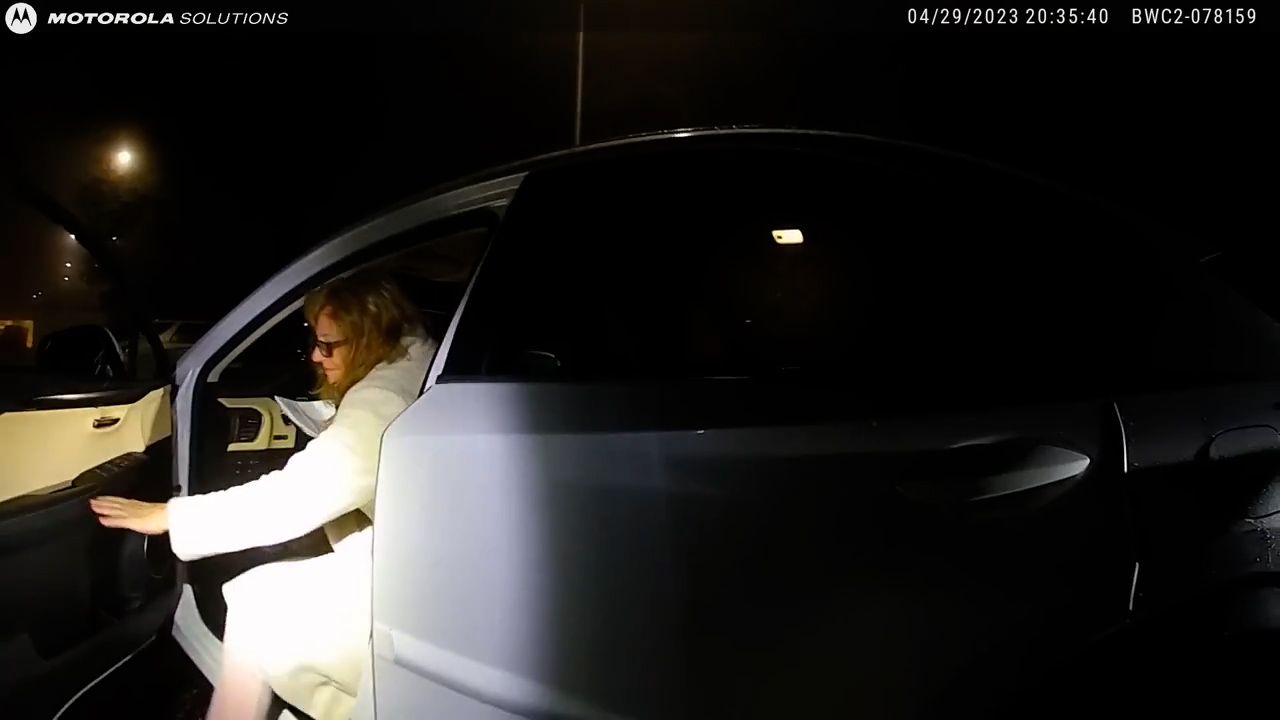

Highlands, NJ — On a foggy April evening in Highlands, New Jersey, a routine traffic patrol turned into a significant DUI investigation after an officer spotted a white 2020 Lexus NX driving on a completely flat tire.
The incident, which occurred on April 29, 2023, began when Officer Nicholas Curley of the Highlands Police Department noticed the vehicle “whizzing” past his stationary patrol car. The front passenger tire was not just low—it was gone, leaving the vehicle grinding on its metal rim. What followed was a tense interaction captured on bodycam, where the driver, identified as Kathleen Kelley-Belluscio, admitted to “messing up” her car but gave conflicting stories about how much alcohol she had consumed.
This case highlights the dangers of impaired driving and the specific legal consequences of refusing chemical testing in New Jersey. Below, we break down the entire incident, the evidence collected by police, and the legal ramifications of the charges filed.
Can You Get a DUI on a Horse? – Check hear

Table of Contents
Watch the Full Bodycam Footage
Chronological Narrative: The Stop and Investigation
The following account is based directly on the official Highlands Police Department Officer Report and the body camera transcript.
The Initial Observation
At approximately 8:30 PM on April 29, 2023, Officer Curley was stationary in his marked patrol vehicle near the Shadow Lawn Trailer Park. He observed a white Lexus NX traveling north on Ocean Boulevard. The vehicle immediately caught his attention because it was driving on a flat front passenger tire.
Officer Curley pulled out to follow the vehicle. As he trailed the Lexus, he watched the driver fail to come to a complete stop at a stop sign on Ocean Blvd before turning right onto Scenic Drive. At this point, the officer activated his emergency lights to initiate a traffic stop.
However, the driver did not stop immediately. According to the police report, Kelley-Belluscio continued driving the entire length of Scenic Drive before finally pulling into the lower parking lot of the Eastpointe Condos.

First Contact: “I Know I Messed Up My Car”
Officer Curley approached the driver’s side of the vehicle. His body camera was recording. He immediately noticed that the driver, Kathleen Kelley-Belluscio, was not wearing her seatbelt.
As he spoke to her, Officer Curley detected a “strong odor of alcoholic beverage” coming from inside the vehicle. The damage to the car was obvious, and Kelley-Belluscio seemed aware of it.
“I know I missed that corner and I know I messed up my car,” she told the officer.
When the officer asked what happened, she replied, “I turned the corner too quickly in the fog.”
Officer Curley noted that her speech was slurred, her eyes were watery, and her hand movements were “slow and fumbling” as she tried to locate her documents. When asked for her credentials, she struggled to find them, at one point handing the officer paperwork that was expired.
The Admission
During the initial interview, Officer Curley asked the standard question used in almost every DUI investigation: “You know how much I have to drink tonight?”
“Not a lot,” Kelley-Belluscio replied.
The officer pressed for specifics. “How much?”
“A beer,” she admitted.
However, her story became confusing. She stated she drank the beer “upstairs in my apartment.” This statement puzzled the officer because she was currently driving towards her apartment complex, implying she had been drinking somewhere else before getting behind the wheel.
Standard Field Sobriety Tests (SFSTs)

Suspecting impairment, Officer Curley asked Kelley-Belluscio to step out of the vehicle to perform Standard Field Sobriety Tests. The officer noted that he could smell alcohol on her breath even outside the car.
1. The Walk and Turn Test
Officer Curley instructed Kelley-Belluscio to stand on a flat area. He explained the “Walk and Turn” test, which requires the suspect to take nine heel-to-toe steps, turn, and take nine steps back.
From the start, Kelley-Belluscio struggled to follow instructions. The officer instructed her to stay in the starting position multiple times, but she kept breaking her stance.
“I didn’t tell you to begin,” the officer had to repeat.
When she finally attempted the test, the police report notes she failed to walk heel-to-toe, was unsteady on her feet, and had difficulty walking in a straight line. She used her arms for balance, which is a “clue” officers look for to determine impairment.
2. The One Leg Stand Test
Next, the officer administered the “One Leg Stand” test. The suspect is required to lift one foot six inches off the ground and count aloud until told to stop.
Kelley-Belluscio swayed and had to hold onto her vehicle for support. According to the report, she could not keep her foot raised for more than three seconds. Furthermore, when she put her foot down, she didn’t resume counting where she left off; she restarted from the number one.
“I’m like completely freaked out about what I did to my car,” she told the officer during the test, attempting to explain her nervousness.
3. The Alphabet and Finger Agility Tests
Officer Curley asked her to recite the alphabet. While she completed this task adequately, she admitted she was “a little fuzzy on it.”
During the finger agility test (touching thumb to fingers while counting), she stopped before being told to and struggled to keep the correct count.
The Arrest
Based on her driving (the flat tire and stop sign violation), the physical signs of impairment (odor of alcohol, slurred speech), and her performance on the sobriety tests, Officer Curley informed Kelley-Belluscio she was under arrest for driving under the influence.
She was handcuffed and placed in the back of the patrol car. At this point, her story changed. She claimed she was not under the influence of alcohol but had taken medications. However, Officer Curley noted that the “odor of alcohol filled my patrol vehicle.”
Back at headquarters, officers read her the Miranda Rights, which she signed. However, when asked to submit to a breathalyzer test—a standard requirement under New Jersey’s implied consent laws—she answered “No.”
The officer warned her that refusing the test is a separate offense with severe penalties. He read the warning a second time. She still answered “No.”
Charges Filed Against Kathleen Kelley-Belluscio
Following the investigation, the Highlands Police Department filed multiple charges against the defendant. The combination of traffic violations and the refusal to test resulted in a heavy list of citations.
- Driving Under the Influence of Alcohol (39:4-50)
- Refusal to Submit to Chemical Testing (39:4-50.4A)
- Reckless Driving (39:5-96)
- Vehicle in Unsafe Condition (39:3-44)
- Failure to Observe Stop Sign (39:4-144)
- Use of Seat Belts (39:3-76.21)
Legal Explanation of Charges
| Charge | Simple Legal Meaning | Why Police Applied It |
|---|---|---|
| DUI (Alcohol) | Operating a vehicle while impaired by alcohol or drugs to the point where you cannot drive safely. | The officer observed erratic driving (hitting a curb, flat tire), smelled alcohol, and the driver failed sobriety tests. |
| Refusal to Submit | Violating “Implied Consent” laws by saying “no” to a breathalyzer test after being arrested for DUI. | Kelley-Belluscio explicitly answered “No” twice when asked to provide breath samples at the station. |
| Reckless Driving | Driving with a “willful or wanton disregard” for the safety of others. | Driving on a rim with a flat tire creates a significant danger to other motorists and pedestrians. |
| Unsafe Vehicle | Driving a car that is in a dangerous condition. | The Lexus had a completely flat front passenger tire and was being driven on the rim. |
| Failure to Observe Stop Sign | Not coming to a full, complete halt at a stop sign. | Officer Curley witnessed her roll through the stop sign at Ocean Blvd and Scenic Dr. |
| Seatbelt Violation | Failure to wear a safety belt while the vehicle is in motion. | The officer observed she was not buckled in when he approached the window. |
If you want to understand more about how traffic stops escalate into criminal charges, read our guide on Traffic Stop Laws and Driver Rights.
What Happened Before Police Arrived
The police report provides context on why Officer Curley was in the area. He was stationed at the entrance of the Shadow Lawn Trailer Park, monitoring traffic.
The body camera transcript reveals a candid conversation between Officer Curley and Officer Hartsgrove (who arrived to assist). Curley described seeing the Lexus “whizzing by” him on the highway.
“She goes whizzing by me. I’m like, what the hell?” Curley told his partner. “I’m like, she’s driving on a flat tire.”
The officers discussed the condition of the driver. Officer Curley mentioned, “She reeks of booze… I’m sure she’s, like, not a lot.” This indicates that before the formal tests even began, the officers had formed a strong suspicion based on their initial observations of the vehicle’s motion and the driver’s scent.
Kelley-Belluscio’s statement that she “missed the corner” suggests the accident that caused the flat tire happened shortly before the officer saw her. She claimed she was coming from “down the hill” or the “7-Eleven.”
Expert Legal Analysis
By Evidence Decode Legal Team
As legal analysts reviewing this case, we look at whether the Fourth Amendment rights of the driver were respected and if the police established the necessary “Probable Cause” for the arrest.
1. The Legality of the Stop
Under US law, a police officer must have “Reasonable Suspicion” that a crime or traffic violation has occurred to pull someone over. In this case, the justification is textbook.
- The Flat Tire: Driving a vehicle on a rim is a violation of Vehicle Equipment Laws (Unsafe Vehicle). This alone justified the stop.
- The Stop Sign: The officer witnessed a moving violation (Failure to Observe Stop Sign).
There is virtually no defense argument to suppress the stop itself. The officer had a legal right to detain the vehicle.
2. Probable Cause for DUI Arrest
To move from a traffic stop to a DUI arrest, the officer needs “Probable Cause.” The Highlands Police Department built this through a “totality of the circumstances”:
- Admission: The driver admitted to drinking “a beer.”
- Odor: Both officers noted a strong smell of alcohol.
- Performance: The failure of the Field Sobriety Tests provides physical evidence of impairment.
- Driving Behavior: Hitting a curb and driving on a flat tire suggests a lack of judgment and motor control consistent with intoxication.
3. The Refusal Issue
New Jersey is an “Implied Consent” state. This means that by driving on NJ roads, you implicitly agree to submit to breath testing if arrested for DUI.
- The Consequence: Refusing the test is often harder to defend than the DUI itself.
- Officer Protocol: Officer Curley followed procedure by reading the “Standard Statement” twice.
4. Defense Considerations
A defense attorney might argue that the driver’s unsteady balance during the “Walk and Turn” and “One Leg Stand” tests was caused by shock from the accident or her footwear (“I don’t have my slippers all the way on”), rather than alcohol. However, the strong odor of alcohol and the admission of drinking make this a difficult hill to climb.
For more on how lawyers challenge these tests, see our article on Defending Against Field Sobriety Tests.
Current Status
Following her arrest, Kathleen Kelley-Belluscio was processed at the Highlands Police Headquarters.
- Release: She was eventually released to a sober party (a friend) later that evening.
- Vehicle: Under John’s Law (a NJ law mandating impoundment for DUI cases), her vehicle was towed and impounded for a mandatory 12-hour period.
- Court: She was issued a summons to appear in Highlands Municipal Court.
The disposition of the case in the police report is listed as “CAA” (Cleared by Arrest) on 04/29/23. As of the printing of the report in November 2025, the case is marked as complete.
For updates on this case and others involved in New Jersey Crime News, keep following Evidence Decode.
Download Full Police Report PDF
Disclaimer
All suspects mentioned in this article, including Kathleen Kelley-Belluscio, are presumed innocent until proven guilty in a court of law. This article is based on official police records, incident reports, and public bodycam footage provided by the Highlands Police Department. This content is for news reporting and educational purposes only.
Why can’t you let us know what happens in court?