
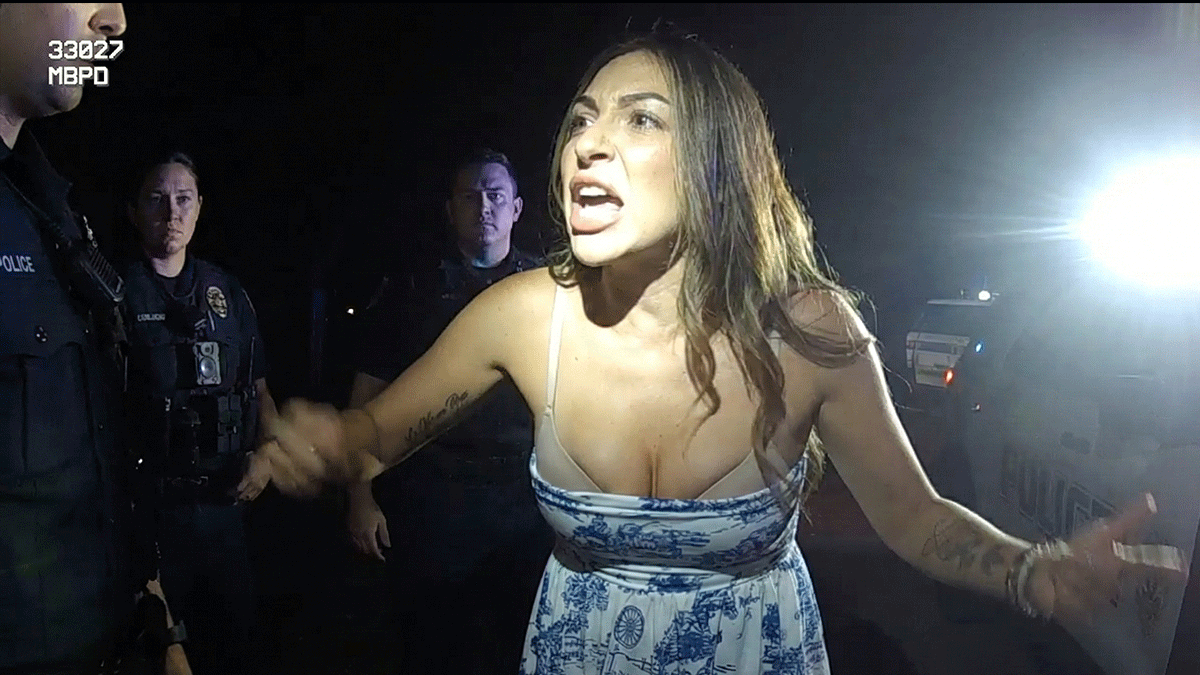

A late-night traffic stop in the quiet borough of Monmouth Beach quickly turned into a high-stakes investigation when a driver allegedly tried to “black out” and hide from a patrol officer. The Monmouth Beach DWI Arrest of 30-year-old Courtney V. Loglisci has drawn attention after police dashcam and bodycam footage revealed a series of tactical errors by the driver that led directly to her apprehension.
Table of Contents
Watch: Monmouth Beach DWI Arrest Caught on Camera
Note: Pay close attention to the timestamp at 00:01:03 in the bodycam transcript where the officer confronts the driver about shutting off her lights in a stranger’s driveway to avoid detection.
Full Story: How the Incident Unfolded
The incident began at approximately 12:52 AM on September 3, 2024. Ptl. Matthew Golembieski was conducting stationary radar enforcement on Ocean Avenue, a road with a posted 35 MPH speed limit. Suddenly, a red 2023 Hyundai Elantra sped past his location. The officer’s radar unit confirmed the vehicle was traveling at 54 MPH—nearly 20 miles over the limit.
As Ptl. Golembieski pulled onto the road to close the gap, the driver made a series of sudden turns. In a move the officer described as an attempt to “duck” the police, the Hyundai turned onto Beach Road, shut off its headlights entirely, and pulled into a private driveway at 7 Beach Road.
When the officer approached the vehicle, he found Courtney Loglisci in the driver’s seat. She reportedly told the officer she lived at the Channel Club Towers, which was blocks away from where she had parked. When asked why she pulled into a stranger’s driveway and turned off her lights, she allegedly admitted, “I saw you guys coming.”
The officer immediately noted several signs of intoxication:
- Strong odor of alcohol coming from the vehicle and later Loglisci’s person.
- Bloodshot, watery eyes with droopy eyelids.
- Admissions of drinking: Loglisci stated she had been at the Wine Loft and had “vodka club” drinks just five minutes before driving.

The Investigation: Smells, Slurs, and SFSTs
Because of the “driving behavior” and the physical signs of impairment, Ptl. Golembieski asked Loglisci to step out for Field Sobriety Tests (SFSTs). The conditions were dark and the night air was “freezing,” according to the driver.
Horizontal Gaze Nystagmus (HGN)
During the HGN test, where the officer uses a red-light pen to track eye movement, Loglisci showed “6 out of 6” clues of impairment. Her eyes were unable to track the stimulus smoothly, showing distinct jerking at maximum deviation.
Walk and Turn (WAT)
This test requires the subject to walk nine steps, heel-to-toe, along a straight line. Loglisci struggled significantly here:
- She lost her balance during the instructions.
- She started the test before being told to begin.
- She missed heel-to-toe contact multiple times and performed an improper turn.
- The officer recorded 7 out of 8 possible clues for this test.
One Leg Stand (OLS)
Loglisci was asked to hold one foot six inches off the ground while counting. She swayed while balancing and had to put her foot down to steady herself. She also used her arms for balance, which is a recognized “clue” of impairment.

The Science of Impairment: Alcotest Results
After being placed under arrest and transported to the Monmouth Beach Police Department (MBPD), Loglisci underwent a formal breathalyzer test using the Alcotest 9510.
The Monmouth Beach DWI Arrest report details a mandatory 20-minute observation period to ensure no foreign substances (like burping or mouthwash) interfered with the results. During processing, Loglisci admitted she had actually consumed four Vodka Sodas between 7:00 PM and 11:30 PM.
The results were definitive:
- First Sample: 0.117% BAC
- Second Sample: 0.112% BAC
- Final Reported Result: 0.114% BAC
In New Jersey, a BAC of 0.08% or higher is considered legally intoxicated. Loglisci’s levels were significantly above this threshold.
The Arrest: Charges Against Courtney Loglisci
Following the investigation, Loglisci was issued five different summonses. Her vehicle was impounded for 12 hours under “John’s Law,” a New Jersey statute designed to keep intoxicated drivers from returning to their vehicles immediately after being released.
| Charge | Simple Explanation | Potential Penalty (NJ First Offense) |
| 39:4-50 | Driving While Intoxicated (DWI) | License loss, $250-$400 fine, IDRC, Ignition Interlock |
| 39:4-96 | Reckless Driving | Fines, up to 60 days jail, 5 points |
| 39:4-97 | Careless Driving | Fines, 2 points |
| 39:4-98 | Speeding (54 in a 35) | Fines, 4 points |
| 39:3-47a | Failure to Use Lamps | Fines |

Did you know? You can check arrest records for anyone in your neighborhood instantly. [Search Public Records Here]
Legal Analysis: Was the Monmouth Beach DWI Arrest Justified?
From a legal perspective, the Monmouth Beach DWI Arrest appears to follow standard New Jersey police protocol.
Fourth Amendment Check
The initial “stop” was justified by the speeding violation (54 MPH in a 35 MPH zone). Police do not need to prove intoxication to pull a car over; they only need “reasonable suspicion” of a motor vehicle violation. The radar reading provided that evidence.
Police Protocol
Ptl. Golembieski followed the National Highway Traffic Safety Administration (NHTSA) guidelines for the three phases of a DWI detection:
- Vehicle in Motion: Observing the speeding and the attempt to hide.
- Personal Contact: Observing the odor of alcohol and watery eyes.
- Pre-Arrest Screening: Conducting the HGN, WAT, and OLS tests.
The officer’s use of a bodycam (BWC 27) ensures that his observations of Loglisci swaying and missing steps are preserved as evidence.
[Read more Evidence Decode investigations here]
Frequently Asked Questions (FAQ) Regarding Courtney Loglisci’s DWI Case
Why was the driver charged with Reckless Driving in addition to DWI?
In New Jersey, a DWI charge (39:4-50) is often accompanied by a Reckless Driving charge (39:4-96) when the driver’s actions show a willful disregard for safety. In this case, the officer cited high-speed travel (54 MPH in a 35 MPH zone) and the driver’s attempt to evade detection by shutting off her vehicle’s lights while pulling into a private driveway as grounds for the additional reckless driving charge.
What is “John’s Law,” and how did it affect this incident?
“John’s Law” is a New Jersey statute that requires police to impound a vehicle for at least 12 hours following a DWI arrest. This law was enacted to prevent intoxicated individuals from being released from custody and immediately getting back behind the wheel. In this incident, Loglisci’s red Hyundai Elantra was towed by Hennessey’s Towing and held under this mandatory 12-hour provision.
Can a driver be penalized for a BAC of 0.114% if they passed some parts of the sobriety tests?
Yes. While the driver may feel they “passed” certain aspects, the Alcotest 9510 results of 0.114% BAC provide scientific evidence of being over the 0.08% legal limit. Furthermore, the officer documented “clues of impairment” across all tests—6/6 on the HGN, 7/8 on the Walk and Turn, and 3/4 on the One Leg Stand—which collectively establish “probable cause” for the arrest regardless of the driver’s self-perception.
What are the legal implications for the “Sober Friend” who picked up the driver?
When Alexandra Mezzina arrived to take custody of Loglisci, she was required to sign a “Potential Liability Warning” form. This document officially advises the person taking custody that they can be held criminally or civilly liable if they permit the intoxicated individual to operate a motor vehicle while they are still impaired.
Does a driver’s prescription medication, like Lexapro, affect a DWI case?
In this case, Loglisci admitted to taking Lexapro for anxiety. Under New Jersey law (39:4-50), a DWI charge applies to being under the influence of “intoxicating liquor, narcotic, hallucinogenic or habit-producing drugs”. While Lexapro is a legal prescription, if its interaction with alcohol further impairs a driver’s ability to operate a vehicle safely, it can be factored into the overall assessment of impairment.

Conclusion & Current Status
Courtney Loglisci was processed at the Monmouth Beach Police Department and later released into the custody of a sober friend, Alexandra Mezzina. As part of the release, Mezzina had to sign a “Potential Liability Warning,” acknowledging that she could be held liable if she allowed Loglisci to drive again while still intoxicated.
Loglisci was required to appear in the Monmouth Beach Municipal Court on October 17, 2024, to answer for the five charges. Her vehicle has since been released back to her.
Download Police Report click here.
Disclaimer: All suspects are presumed innocent until proven guilty in a court of law. This report is based on official police records from Incident 24MB05865.
Don’t Rely on Their Word Alone In this case, conflicting stories led to an arrest. The only way to prove your innocence in a traffic stop is with your own 4K evidence. Protect yourself this holiday season. 🎄 Click Here