


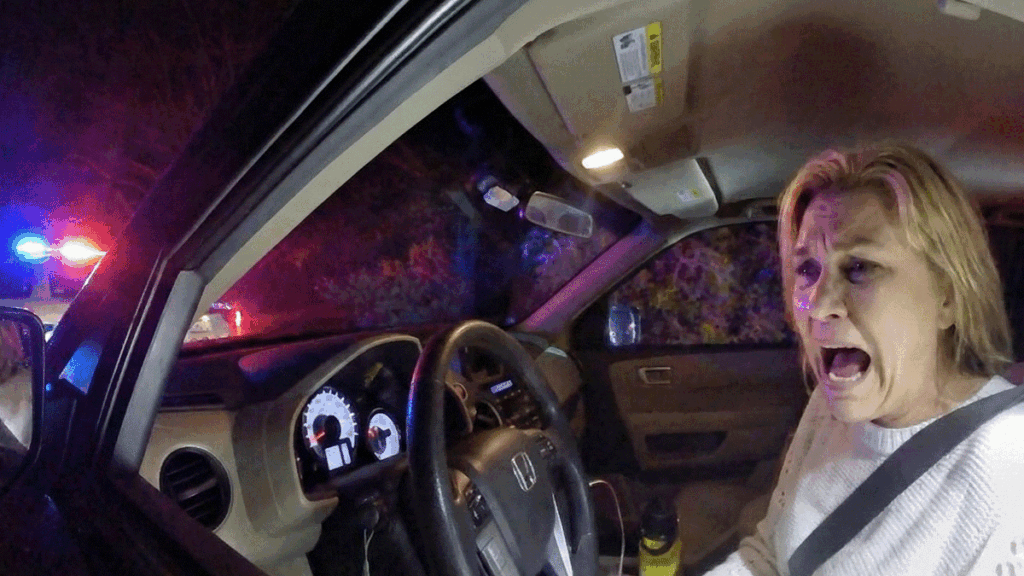
“I’m not very good at balancing,” a woman told officers during a midnight Colts Neck DUI Arrest after she was caught swerving across the shoulder of Route 18. Police in Colts Neck, New Jersey, arrested 50-year-old Mary A. Lucash on May 4, 2024, after a harrowing roadside investigation. What began as a simple lane violation quickly escalated into a high-stakes criminal investigation involving slurred speech, a bottle of rosé, and a blood alcohol content (BAC) more than twice the legal limit.
Table of Contents
Watch: Colts Neck DUI Arrest Caught on Camera
Note: Pay close attention to the timestamp at 00:17:35 where the suspect completely stops the “One Leg Stand” test, leading the officer to terminate the evaluation for her own safety.
Full Story: How the Incident Unfolded
The incident began at approximately 10:23 p.m. on Saturday night. P.O. Forgach was patrolling Northbound State Route 18 when he spotted a red Honda Pilot failing to maintain its lane. The vehicle repeatedly crossed the solid white shoulder line with its passenger-side tires.
Officer Forgach activated his emergency lights, but the driver did not pull over immediately. When the vehicle finally stopped at mile marker 18.4, the officer approached the passenger side and was immediately met with the smell of alcohol.
A “Bottle of Wine” and Slurred Speech
The driver, identified as Mary Lucash of Old Bridge, NJ, appeared to have slow hand movements and bloodshot eyes. When asked where she was coming from, she stated she had been at a friend’s house in Tinton Falls.
The conversation took a critical turn when the officer asked if she had been drinking. “A little bit,” she initially replied. When pressed, she stuttered and admitted to consuming a full “bottle of wine” — specifically rosé — shared between three people.

The Field Sobriety Failure
The Colts Neck DUI Arrest investigation moved to the pavement of SR 18 for Standardized Field Sobriety Tests (SFSTs). Lucash struggled from the start, stumbling as she walked to the rear of her vehicle.
- Walk and Turn: Lucash could not hold the starting position and stumbled continually. During the test, she failed to walk heel-to-toe and used her arms for balance.
- One Leg Stand: This test was even more difficult. Lucash repeatedly put her foot down and could not count past “1005.”
Seeing the suspect’s inability to maintain balance, Officer Forgach ended the tests early. “For the safety of your well-being, I want to conclude the test there,” he told her before placing her in handcuffs.
The Arrest: Charges Against Mary Lucash
After being transported to headquarters, Lucash provided breath samples. The Alcotest 9510 recorded a BAC of 0.178%, significantly higher than New Jersey’s 0.08% legal limit.
| Charge | Simple Explanation | Potential Penalty (NJ) |
| DWI (39:4-50) | Driving while under the influence of alcohol. | Fines, IDRC, and ignition interlock installation. |
| Reckless Driving (39:4-96) | Driving with a willful disregard for safety. | Fines and potential points on license. |
| Marked Lanes (39:4-88) | Failure to keep the vehicle within a single lane. | Traffic fines and court costs. |
Did you know? You can check arrest records for anyone in your neighborhood instantly. [Search Public Records Here]
Legal Analysis: Was the Colts Neck DUI Arrest Justified?
From a legal standpoint, the officers followed standard New Jersey procedure.
- The Initial Stop: Under the Fourth Amendment, a police officer needs “reasonable suspicion” to stop a vehicle. Forgach’s observation of the vehicle crossing the shoulder line multiple times provided clear legal grounds for the stop.
- The Search: Officers searched the vehicle for intoxicants incident to the arrest. While the search yielded negative results, the “odor of an alcoholic beverage” emanating from the suspect and the vehicle cabin provided probable cause for the investigation.
- Miranda Rights: The transcript shows that Lucash was read her Miranda rights at headquarters. She initialed the form but ultimately invoked her right to remain silent regarding further questioning.
[Read more Evidence Decode investigations here]
Here are 5 frequently asked questions (FAQs) regarding the legal consequences and procedures
What are the specific penalties for a first-time DWI with a BAC as high as 0.178%?
In New Jersey, a blood alcohol content (BAC) of 0.15% or higher triggers more severe penalties than a standard DWI. For a first offense with this level of intoxication, the court mandates the installation of an ignition interlock device during the license suspension period and for an additional 9 to 15 months after driving privileges are restored. Additionally, the driver faces a mandatory license suspension of 4 to 6 months.
Why was the suspect’s vehicle impounded for 12 hours?
The vehicle was impounded under a New Jersey statute known as “John’s Law” (N.J.S.A. 39:4-50.23). This law requires law enforcement to impound the vehicle of any person arrested for DWI for a minimum of 12 hours to ensure the intoxicated individual does not immediately return to the road and pose a further threat. The owner or an authorized representative can only reclaim the vehicle after this “cooling-off” period by showing a valid license and proof of insurance.
How many points are added to a driver’s license for the secondary charges in this case?
While a DWI itself does not carry points in New Jersey, the secondary charges often issued alongside it do:
Reckless Driving (39:4-96): This charge adds 5 points to the driver’s record.
Failure to Maintain Lane (39:4-88): This charge adds 2 points to the driver’s record. Accumulating 12 or more points can lead to an automatic license suspension by the Motor Vehicle Commission.
What is the “Intoxicated Driver Resource Center” (IDRC) requirement?
Anyone convicted of a DWI in New Jersey must participate in a program at the Intoxicated Driver Resource Center (IDRC). For a first offense, this typically involves 12 to 48 hours of mandatory alcohol education and substance abuse assessment. Failure to complete the assigned IDRC hours or follow-up treatment can result in further jail time and extended license suspension.
What are the long-term financial costs beyond court fines?
A DWI conviction includes significant “hidden” costs that last for years. The most substantial is the mandatory automobile insurance surcharge of $1,000 per year for three years, totaling $3,000. Other mandatory fees often include a $100 Drunk Driving Enforcement Fund fee, a $100 Alcohol Education and Rehabilitation Fund fee, and a $100 license restoration fee.
Conclusion & Current Status
Mary Lucash was processed at the Colts Neck Police Department and later released into the custody of her husband, Francis Lucash Jr. Under “John’s Law,” her vehicle was impounded for a mandatory period.
She faces multiple traffic summonses and a pending court date in Colts Neck Municipal Court to answer for the 0.178% BAC reading.

Download Police Report click here.
Disclaimer: All suspects are presumed innocent until proven guilty in a court of law. This report is based on official police records and bodycam transcripts.
Don’t Rely on Their Word Alone In this case, conflicting stories led to an arrest. The only way to prove your innocence in a traffic stop is with your own 4K evidence. Protect yourself this holiday season. 🎄 Click Here