
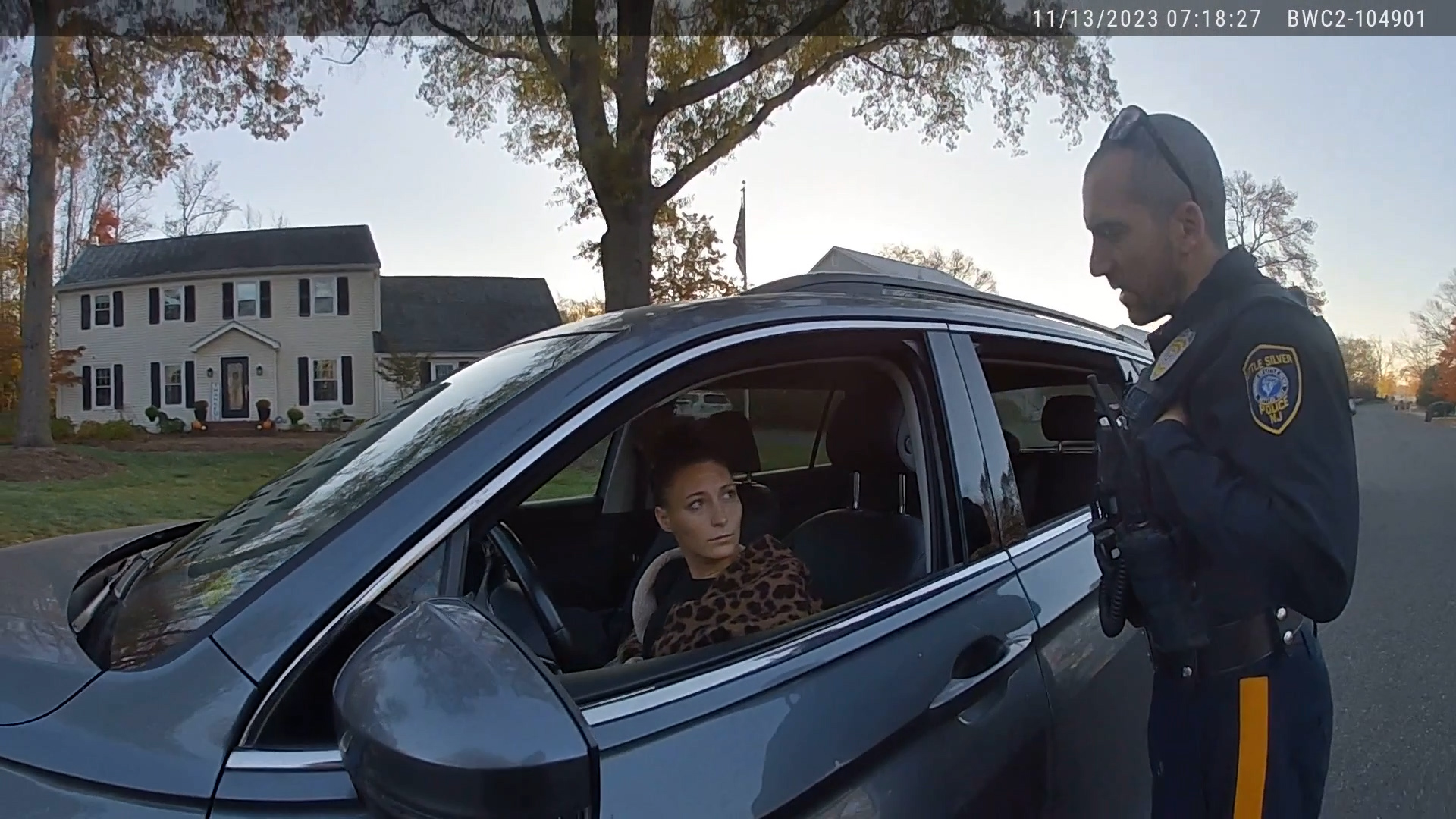

In the quiet, early morning hours of November 13, 2023, a concerning 911 call led police to a residential street in Little Silver, New Jersey, where a grey Volkswagen had been parked for hours with a woman slumped over the steering wheel. What began as a routine welfare check by the Little Silver Police Department quickly escalated into a tense roadside narcotics investigation. Detective Stephen Scherer arrived at the scene on Breezy Point Road to find 29-year-old Amber DiBenedetto, who claimed she was an exhausted Uber driver just taking a nap. However, official police reports and bodycam footage reveal a much darker reality involving alleged heroin paraphernalia, unprescribed pills, and a struggle with sobriety. The footage is now drawing attention for its raw depiction of how police differentiate between a tired worker and a suspect under the influence, as well as the suspect’s desperate attempts to explain away the drugs found in her possession.
Table of Contents
Watch the Full Bodycam Footage
Full Chronological Narrative (Full Details)
The Initial Approach
The incident began shortly after 7:00 AM on a cold November morning. Detective Stephen Scherer approached a grey 2019 Volkswagen parked on Breezy Point Road. A concerned citizen had reported the vehicle, noting that it had been idling there since approximately 5:00 AM.
When Det. Scherer approached the window, he found a female driver, later identified as Amber DiBenedetto, slumped heavily to her right side. The officer had to knock to rouse her. When she finally woke up, she appeared disoriented.
“You sure you don’t need anything?” Det. Scherer asked immediately, assessing her medical state. “Look at the mark on your head again… I saw you with your head over to your right”.
DiBenedetto brushed off the concern, claiming the red mark on her forehead was simply from sleeping on the steering wheel. “I didn’t like… I like the crowd tired. And they had a long day,” she stammered, attempting to explain her presence. She told the officer she drove for Uber and had dropped a passenger off nearby before pulling over to rest.
The Investigation Deepens
The officer was skeptical of her story. He pointed out that she had been there for over two hours.
“So you’ve been here since five?” the officer asked.
“I didn’t want you to know,” she replied, her speech somewhat fragmented.
Det. Scherer engaged her in conversation to gauge her cognitive function. He asked about her drop-off location and her passengers. DiBenedetto claimed she dropped a friend named “Brian” in Oceanport, but her details were vague. As the conversation continued, the officer’s suspicion shifted from fatigue to potential impairment. He asked her directly about her history with narcotics.
“When was the last time you used?” Det. Scherer asked.
“A long time,” DiBenedetto replied. She eventually clarified that “a long time” meant months, but also stated she had been clean from heroin for seven years. She admitted to currently taking Suboxone, a medication used to treat opioid addiction.
Field Sobriety Tests
Concerned about her ability to drive, Det. Scherer asked DiBenedetto to step out of the vehicle. “Being that you were sleeping in the car and then you have some previous drug history… I just want to make sure you’re okay driving,” he explained.

He administered a series of Field Sobriety Tests (FSTs).
First, he checked her eyes using the Horizontal Gaze Nystagmus test. “Follow my pen with your eyes… don’t move your head,” he instructed.
DiBenedetto struggled to follow instructions, moving her head instead of just her eyes multiple times. “You could barely follow all the time… You were moving your head,” the officer later noted.
Next was the “Walk and Turn” test. The officer instructed her to walk nine steps heel-to-toe along a straight line. DiBenedetto seemed nervous and unsteady.
“I’m shaking,” she admitted.
“Do not start to walk until I ask you again,” the officer commanded, but she struggled to maintain the starting position.
The Discovery of the Pills
The turning point in the encounter occurred when Det. Scherer spotted a pill bottle. He asked to see it. Inside were various pills, including “green bars” and white tablets that DiBenedetto could not identify.
“What’s the other stuff in here?” the officer asked, referring to the unidentified green pills.
“I don’t know what that means. I have to be honest, I really don’t,” DiBenedetto replied.
She attempted to distance herself from the contents of the bottle, offering a complicated backstory about her family.
“This is why I got evicted… because my mom, my sister was sharing with me as well… they had been doing like drugs like their whole entire life,” she explained. She claimed they had stayed at her house and left the pills behind.
The Arrest
The officer was not swayed by her explanation that she was unknowingly carrying someone else’s drugs in her car.
“You are being [placed] on police [hold]… for all the medication that you have on you, that’s not yours,” Det. Scherer stated.
As he prepared to arrest her, he asked a crucial safety question: “Do you have any needles?”.
“Yes,” she admitted.

This admission confirmed the presence of drug paraphernalia. During the subsequent search of her belongings, the officer discovered significant evidence. He remarked to another officer on the scene, “That’s what I found in the pocket… Wow. Okay”. The search uncovered “cotton balls,” which the officer explained to a colleague are often used to filter heroin when injecting.
DiBenedetto was handcuffed and placed in the back of the patrol vehicle. The situation ended with her being transported to Riverview Medical Center for evaluation before being processed at headquarters.
Charges Filed Against Amber DiBenedetto
Following the investigation on Breezy Point Road, the Little Silver Police Department filed three specific criminal charges against Amber DiBenedetto. These charges reflect the discovery of illegal substances and the tools used to consume them.
- Possession of CDS (Controlled Dangerous Substance)
- Possession of Drug Paraphernalia
- Possession of Prescription Drugs in Original Container (Violation)
Legal Breakdown of Charges
| Charge Name | Simple Legal Meaning | Potential Penalties (NJ) | Why Officers Applied This |
| Possession of CDS (N.J.S.A. 2C:35-10A(1)) | It is illegal to have “hard” drugs (like heroin, cocaine, or unprescribed Schedule I-IV drugs) in your possession. | This is typically a 3rd-Degree Crime. It can carry 3 to 5 years in prison and fines up to $35,000. | Officers found pills (“green bars” likely Xanax/Alprazolam) and potentially heroin residue that DiBenedetto admitted were “illegal” or not hers. |
| Possession of Drug Paraphernalia (N.J.S.A. 2C:36-2) | It is illegal to have items used to plant, make, package, or use illegal drugs. | This is a Disorderly Persons Offense. Penalties include up to 6 months in jail and a fine of up to $1,000. | DiBenedetto admitted to having needles in the car. Officers also found cotton balls used for filtering drugs. |
| Possession of Prescription Drugs Outside Container (N.J.S.A. 2C:35-24) | You must keep prescription pills in the bottle they came in, with your name on it. Holding loose pills or pills in a mismatched bottle is a crime. | This is a Disorderly Persons Offense. Penalties include up to 6 months in jail and a fine of up to $1,000. | The officer found a bottle containing mixed pills (green and white) that did not match the label or belonged to someone else. |
Why This Case is Serious
While a “sleeping driver” call might sound minor, this case highlights the serious legal jeopardy of “Constructive Possession.” In the United States, you can be charged with possession of drugs found in your car, even if you claim they belong to a passenger or family member. DiBenedetto’s admission that the pills were not hers, yet were in her control, gave police the grounds for these serious charges.
What Happened Before Police Arrived
The timeline of this incident reveals that Amber DiBenedetto had been parked on the residential street for a significant amount of time before police intervened.
- The 911 Call: A resident or passerby noticed the grey Volkswagen parked on Breezy Point Road. The caller reported that the vehicle had been stationary at that location since approximately 5:00 AM.
- The Suspect’s Movements: DiBenedetto told police she had been driving for Uber or Lyft. She claimed she picked up a friend named Brian and dropped him off in the Oceanport area nearby.
- The “Nap”: After the drop-off, she claimed she was too tired to continue driving and pulled over to sleep. She admitted she had been there for a long time, stating, “I didn’t want you to know” when the officer asked about the duration of her stay.
- Medical State: When the officer arrived, he noted a distinct red mark on her forehead. This suggests she was sleeping with her head pressed hard against the steering wheel or window, confirming she had been in a deep, potentially drug-induced sleep for hours.

Expert Legal Analysis
As a legal analyst reviewing the evidence in the State v. DiBenedetto arrest, several key constitutional and procedural questions arise regarding the officer’s conduct and the suspect’s rights.
1. Reasonable Suspicion vs. Probable Cause
Under the Fourth Amendment, police cannot simply detain a citizen without cause. However, Det. Scherer was responding to a “welfare check” regarding a driver slumped over the wheel. This falls under the “Community Caretaking” doctrine. Police have a right—and duty—to check on an unresponsive driver to ensure they are not having a medical emergency. Once the officer saw the driver was disoriented and admitted to being there for hours, he had Reasonable Suspicion to detain her to investigate potential impairment (DUI/DWI).
2. The Plain View Doctrine
A critical moment in the video is when the officer spots the pill bottle. Under the Plain View Doctrine, if an officer is legally allowed to be where he is (standing by the car window) and sees contraband immediately apparent as illegal (or suspicious enough to warrant inquiry), he can seize it. When DiBenedetto handed over the bottle and could not identify the “green bars” inside, she provided the officer with Probable Cause to arrest her. Her statement, “I don’t know what that is,” regarding the pills in her own possession, is legally damaging.
3. The Search of the Vehicle
DiBenedetto initially hesitated when asked if the officer could search her car. “I mean… I know you should do…” she trailed off.
The officer then utilized a common investigative tool: the threat of a K9 unit. “I’m going to call a K9 here… and then if he sniffs and hits, then we’ll search the car,” he explained.
This is a legal tactic. However, before the K9 was even necessary, DiBenedetto admitted, “I do have some stuff on me… I have some illegal [items]”. This admission acts as a verbal exception to the warrant requirement, granting the officer full legal authority to search the vehicle for the items she mentioned.
4. The “Not Mine” Defense
DiBenedetto’s primary defense was that the drugs belonged to her mother and sister. In court, this is often a weak defense due to Constructive Possession. The law assumes that as the driver and sole occupant of the vehicle, you have dominion and control over everything inside it. Unless she can prove someone else placed them there without her knowledge, the law treats the drugs as hers.
5. Miranda Rights
The transcript shows Det. Scherer read DiBenedetto her Miranda rights (“You have the right to remain silent…”) at timestamp. This was done correctly before he proceeded to interrogate her further about the specific ownership of the drugs. This ensures that her subsequent admissions about the needles and the “illegal” items are admissible in court.
Conclusion on Protocol
Det. Scherer followed standard procedure. He escalated from a medical check to a DUI investigation, and finally to a narcotics arrest based on the evidence presented. He remained calm and professional, which strengthens the prosecution’s case by removing any argument of coercion.

Current Status
Following her arrest on November 13, 2023, Amber DiBenedetto was not immediately taken to a jail cell. Due to her condition—likely the level of intoxication or the head injury noted by the officer—she was transported by Little Silver EMS to Riverview Medical Center for medical clearance.
The police report indicates she was charged on a Complaint Warrant (Warrant # 1323-W-2023-000053). In New Jersey, a “Warrant” (as opposed to a Summons) often means the suspect is held in county jail pending a detention hearing, rather than being released immediately. The report notes that the Monmouth County Sheriff’s Office watched her at the hospital until she could be transported to the Monmouth County Correctional Institution (MCCI).
As of the date of this report, the case would have moved through the Monmouth County Superior Court system. Given the nature of the charges (3rd-degree possession), such cases often result in plea deals involving “Drug Court” (Recovery Court) probation, especially for defendants with a history of addiction who expressed a desire for help, as DiBenedetto did during the arrest.
Download Full Police Report PDF
Disclaimer
All suspects mentioned are presumed innocent until proven guilty in a court of law. This article is based on official police records and public bodycam footage provided by the Little Silver Police Department. This content is for news reporting and educational purposes only.