
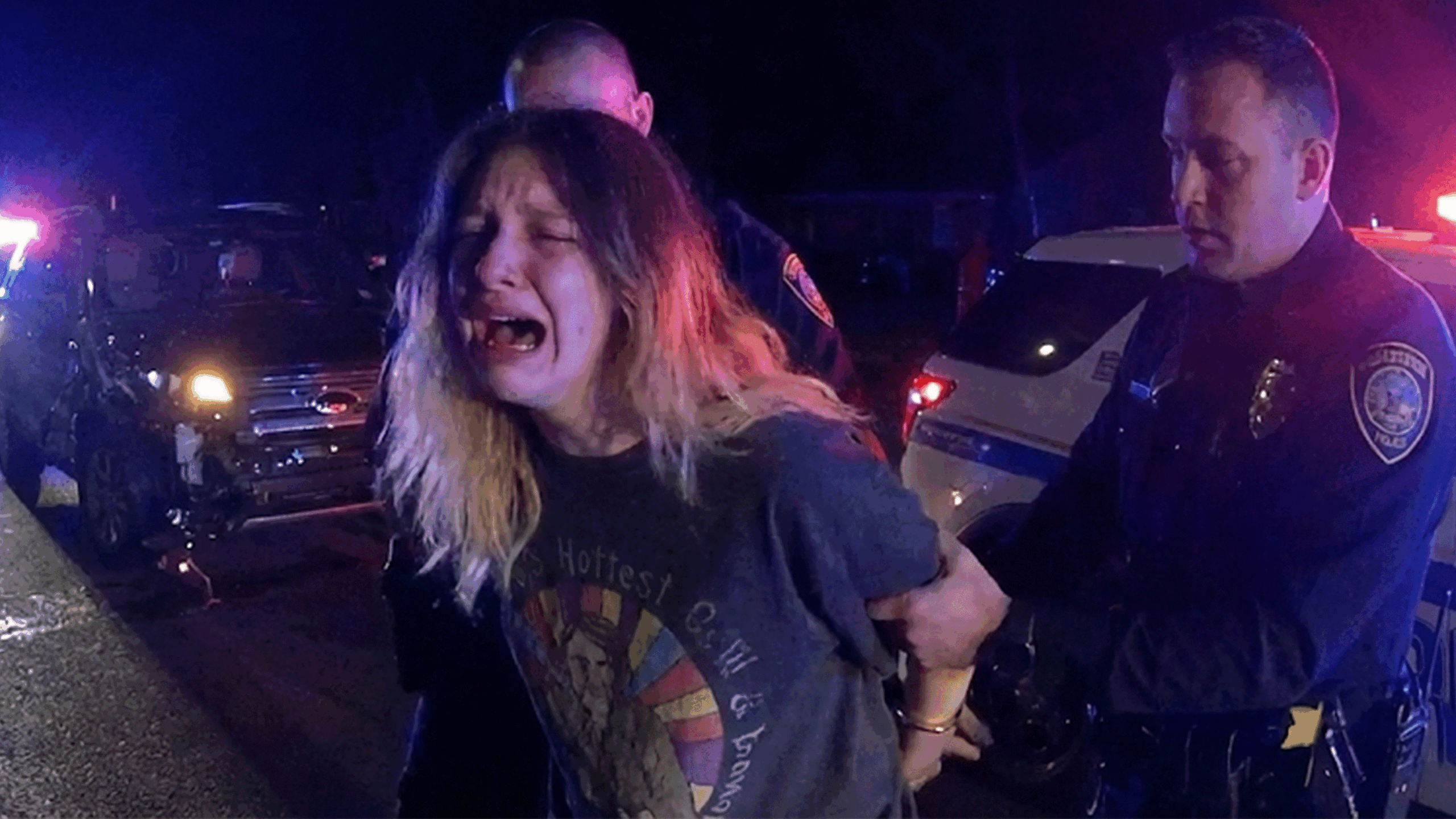

The aftermath of an Athens Georgia Underage DUI Arrest began in the pitch-black parking lot of an apartment complex. A loud crash woke up sleeping residents when a 20-year-old driver slammed her vehicle into a parked car. The young driver, identified as Georgia Ann Laster, claimed she simply overshot her turn while looking for a friend. However, the responding officer soon smelled alcohol on her breath, quickly shifting the routine crash investigation into a full-blown criminal arrest.
Table of Contents
Watch: Athens Georgia Underage DUI Arrest Caught on Camera
Note: Pay close attention to the timestamp at 00:18:53 where the situation escalates. The suspect refuses to submit to a field sobriety test, leading directly to her being placed in handcuffs.
Full Story: How the Incident Unfolded
On January 14, 2022, at approximately 3:20 AM, Athens-Clarke County Police Officer Teets responded to a collision at 101 Davis Street. A black 2004 Ford Explorer driven by 20-year-old Georgia Ann Laster had struck a parked vehicle. The owner of the parked car, Joshua Graves, had been asleep in his apartment before the sound of the crash woke him up.
Laster told the officer that she was driving in the dark and completely missed her turn into the apartment complex. She claimed she had been driving around the block searching for her friend, Ulysses, who had gone for a walk. Because it was dark, she stated she did not see the parked car before hitting it.
While gathering her information, Officer Teets noticed the smell of alcohol coming from Laster’s breath. He also noted that her eyes appeared glossy. When asked if she had consumed any alcohol, Laster initially denied drinking that night.
Moments later, she admitted to drinking vodka the previous night between 10:00 PM and 11:00 PM. Laster confessed to having about four to five shots of vodka. Despite this admission, she firmly refused to participate in any field sobriety tests.
Officer Teets consulted briefly with another officer on the scene to share his observations. He explained that Laster smelled like alcohol, had glossy eyes, and was giving a confusing story about her route. Returning to Laster, Officer Teets officially placed her under arrest for Driving Under the Influence.
Once in the back of the patrol vehicle, the officer read Laster the Georgia Implied Consent warning. This law requires drivers to submit to chemical testing of their blood, breath, or urine to determine alcohol concentration. Laster refused the state-administered blood test. After the officer read the warning a second time, she also refused the breath test.

The Arrest: Charges Against Georgia Ann Laster
Following the crash and her refusal to perform testing, Laster was officially booked into custody. Below is the breakdown of her initial charges filed by the Athens-Clarke County Police Department.
| Charge | Simple Explanation | Potential Penalty (US) |
| DUI – Alcohol – Under 21 YOA (40-6-391(k)) | Driving a vehicle while underage with alcohol in the system. | Fines, probation, license suspension, community service. |
| Failure to Maintain Lane/Improper Driving (40-6-48) | Failing to keep the vehicle in the proper lane of travel, resulting in a crash. | Traffic fines, points on license. |
| Instruction Permits and Temp Licenses (40-5-24) | Violating the restrictions of a temporary driver’s permit. | Fines, potential permit revocation. |
| Underage Possession of Alcohol (3-3-23) | Possessing or consuming alcohol while under the legal drinking age of 21. | Fines, probation, mandatory alcohol education. |
| Operation of Unregistered Vehicle (40-2-8) | Driving a vehicle without a valid, current license plate or registration tag. | Traffic fines. |
Legal Analysis: Was the Athens Georgia Underage DUI Arrest Justified?
When evaluating this case, legal experts look closely at the officer’s “probable cause” to make the arrest. The Fourth Amendment protects citizens from unreasonable searches and seizures, meaning police need clear evidence of a crime to detain someone. In this incident, the officer had multiple legal grounds to investigate.
First, the driver was involved in a single-vehicle collision with a parked car, which immediately established reasonable suspicion of impaired or distracted driving. Second, the officer directly observed the odor of alcohol and glossy eyes, which are standard indicators of intoxication. Third, the suspect openly admitted to consuming four to five shots of vodka just hours before driving.
Under Georgia law, drivers under the age of 21 are subject to strict DUI regulations. If an underage driver operates a vehicle with a blood alcohol concentration of 0.02 grams or more, they are in violation of the law. Because Laster refused the field sobriety tests, the officer had to rely on his physical observations and her own admission of drinking to establish probable cause for the arrest.
Furthermore, the officer strictly followed protocol by reading the Georgia Implied Consent Notice. He explicitly warned her that refusing the state-administered chemical test would result in a minimum one-year suspension of her driver’s license. Because she refused both blood and breath tests, her refusal could legally be used as evidence against her in court.
[Read more Evidence Decode investigations here]
Frequently Asked Questions (FAQs)
What happens if a driver refuses a state-administered chemical test in Georgia?
If a driver refuses chemical testing of their blood, breath, or urine, their Georgia driver’s license (or privilege to drive in the state) will be suspended for a minimum of one year. Furthermore, this refusal can be offered into evidence against the driver at trial.
What blood alcohol concentration (BAC) triggers a suspension for underage drivers in Georgia?
Under Georgia law, if an underage driver submits to testing and the results show an alcohol concentration of just 0.02 grams or more, their driver’s license may be suspended for a minimum of one year. This zero-tolerance approach is reflected in the specific charge of “DUI – Alcohol – Under 21 YOA – Concentration 0.02g”.
Can a driver request their own independent drug or alcohol test?
Yes, but only after complying with the police first. After a driver first submits to the state’s requested chemical test, they are legally entitled to an additional chemical test of their blood, breath, or urine. This secondary test must be conducted by qualified personnel of the driver’s own choosing and at the driver’s own expense.
Will all the charges from a traffic arrest stick on a permanent record?
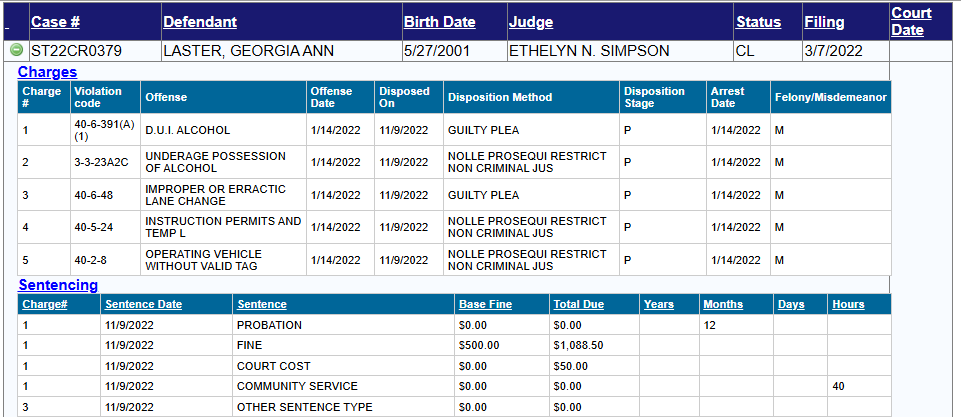
Not necessarily; many cases are resolved through plea agreements. For example, in this case, the driver was initially hit with five separate charges, including Underage Possession of Alcohol and Operation of an Unregistered Vehicle. However, three of those charges were dismissed (Nolle Prosequi), and the defendant only pled guilty to the DUI and the Improper Lane Change.
What are the common penalties for a first-time DUI plea agreement?
Penalties can be strict even for a first offense. Based on the court documents from this incident, a guilty plea for a DUI can result in 12 months of probation, a $500 base fine, and 40 mandatory hours of community service. The court may also order the driver to complete DUI school and undergo a formal substance abuse evaluation.

Conclusion & Current Status
The court system officially resolved this case later that same year. On November 9, 2022, Georgia Ann Laster entered a guilty plea for the primary charges.
She pled guilty to DUI Alcohol and Improper or Erratic Lane Change. In exchange for her plea, the state dismissed the remaining charges: Underage Possession of Alcohol, Instruction Permits violation, and Operating a Vehicle Without a Valid Tag.
The judge sentenced Laster to 12 months of probation. She was also ordered to pay a $500 base fine and complete 40 hours of community service. Additionally, her plea agreement mandated that she attend DUI school and undergo a substance abuse evaluation and treatment.
Download Police Report click here.
Disclaimer: All suspects are presumed innocent until proven guilty in a court of law. This report is based on official police records.
Don’t Rely on Their Word Alone In this case, conflicting stories led to an arrest. The only way to prove your innocence in a traffic stop is with your own 4K evidence. Protect yourself this holiday season. 🎄 Click Here